
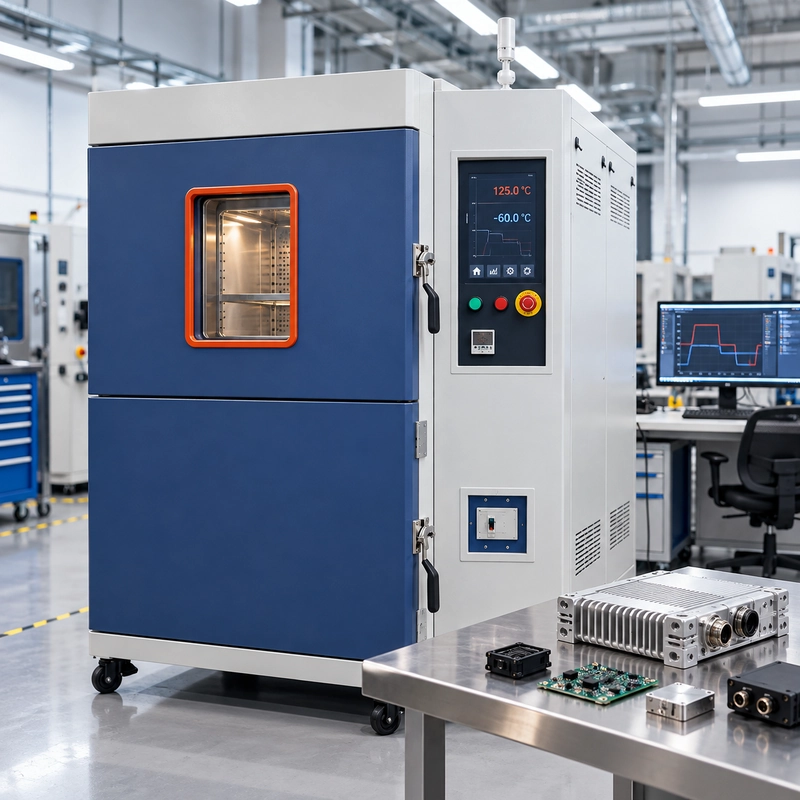
Your test profile bottoms out at −40°C.
Do you buy a −40°C environmental test chamber, or step up to a −70°C model?
The catalog comparison looks easy. One chamber reaches the temperature you need; the other gives you another 30°C of low-temperature capability.
But that is only the range comparison.
Put a 30 kg fixture inside. Power the device under test. Add 500 W of heat. Require the product itself—not just the chamber air—to stabilize at the low-temperature condition. Then specify how quickly the chamber must get there.
Now the decision is different.
Three things need to be kept separate:
Chamber minimum ≠ Test minimum ≠ Loaded performance
That distinction is the key to choosing between a −40°C and −70°C chamber without under-specifying the test—or paying for low-temperature capability you may never use.
The Short Answer: Start With the Test, Not the Chamber
If your actual test goes below −40°C, a chamber whose operating range stops at −40°C does not cover the requirement. A −70°C-class configuration becomes the logical direction.
If your lowest test point is comfortably above −40°C, a −40°C chamber may be all you need, provided it meets the required performance with your actual load.
The interesting case is when the test itself reaches −40°C or comes close to it.
That does not automatically mean you should buy a −70°C chamber.
It means the application deserves a closer look.
You need to know what must reach the low-temperature condition, how much mass is inside the chamber, whether the device is powered, how much heat it generates, how long the low-temperature dwell lasts, and whether cooling rate or humidity control is part of the test.
A useful selection sequence is:
Actual Test Profile → DUT Condition → Loaded Performance → Chamber Range
Not:
Colder Chamber → Better Chamber
What Actually Changes Between −40°C and −70°C?
The obvious difference is the additional 30°C of low-temperature range.
The practical difference goes beyond that.
Producing and maintaining deeper sub-zero conditions places greater demand on the refrigeration system. The exact system design varies by chamber configuration, capacity and performance requirement, so the −40°C/−70°C distinction should not be treated as nothing more than a different thermostat setting.
For initial selection, this is the useful comparison:
| Selection Factor | −40°C Configuration | −70°C Configuration |
|---|---|---|
| Low-temperature range | Down to the −40°C class | Down to the −70°C class |
| Best fit | Tests that stay within the −40°C operating range | Tests requiring deeper sub-zero conditions |
| Low-temperature capability | Less range below common sub-zero test points | Greater available low-temperature range |
| Refrigeration requirement | Generally lower | Generally higher |
| System complexity | Generally lower | Generally higher |
| Utility demand | Generally lower | Potentially higher |
| Main reason to choose it | The test requirement supports it | The test actually needs the additional range |
The last line matters more than the rest.
A −70°C chamber has greater low-temperature capability.
That does not make it the better choice for every test.
Capability is useful when the test uses it.
【IMAGE 1 — INSERT HERE】
−40°C vs −70°C Chamber Range
Show a horizontal temperature scale:
−70°C ━━━━━ −40°C ━━━━━ −20°C ━━━━━ 0°C ━━━━━ +85°C ━━━━━ +150°C
Above:
−40°C CHAMBER
−40°C → +150°C
−70°C CHAMBER
−70°C → +150°C
Below, show three example profiles:
PROFILE A
−20°C → +85°C
Both ranges cover the temperature requirement.
PROFILE B
−40°C → +85°C
At the lower boundary of the −40°C range—verify the application.
PROFILE C
−55°C → +85°C
Outside the −40°C range.
Bottom Caption:
Start with the test profile—not the lowest number on the chamber nameplate.
Suggested Alt Text: -40 vs -70 environmental chamber temperature range
Image Size: 960 × 640 px
Chamber Minimum ≠ Test Minimum ≠ Loaded Performance
Suppose a chamber specification says:
Temperature range: −40°C to +150°C
Your test procedure says:
Low-temperature exposure: −40°C
The numbers match.
That still is not enough information to approve the chamber.
Why? Because they describe different things.
Chamber minimum is the lower boundary of the chamber's specified operating range under the conditions defined by the manufacturer.
Test minimum is the lowest temperature required by the test profile.
Loaded performance is what the chamber can actually achieve and maintain with the required DUT, fixture, heat load and operating conditions inside.
Consider two applications using the same −40°C chamber.
Application A: −30°C test, 5 kg DUT + fixture, 0 W live heat.
Application B: −30°C test, 45 kg DUT + fixture, 900 W live heat.
Both tests sit 10°C above the chamber's nominal minimum.
The nominal margin is identical.
The refrigeration job is not.
This is why there is no universal rule saying you should always leave 5°C, 10°C or 20°C between the required test point and the chamber's minimum rating.
A temperature gap tells you where the test sits within the nominal range. It does not tell you whether the loaded chamber will perform the test.
And if a test point happens to equal the published −40°C lower limit, that does not automatically disqualify a −40°C chamber. It means the required performance should be checked against the manufacturer's stated conditions and the actual application.
What Does “Test at −40°C” Actually Mean?
This question is easy to overlook.
When a test procedure says −40°C, what must reach −40°C?
The chamber setpoint? The circulating air? A sensor next to the DUT? The DUT surface? An internal component?
Those are not necessarily the same thing at the same moment.
Imagine a 25 kg electronic assembly entering a low-temperature cycle.
The chamber controller moves toward −40°C. The chamber air follows. The DUT does not instantly follow with it.
Its temperature lags because the product itself has thermal mass. A thick metal enclosure, battery assembly, dense fixture or insulated product can make that lag more significant.
A simplified sequence might look like this:
Chamber setpoint reaches −40°C
↓
Chamber air approaches/stabilizes at the required condition
↓
DUT temperature continues falling
↓
Required DUT condition is reached
Depending on the test method, the required exposure or dwell may be tied to a defined chamber condition, specimen condition, stabilization criterion or another specified reference.
That definition matters.
A chamber reaching −40°C is not automatically the same as the DUT reaching −40°C.
Before selecting equipment, confirm what the test procedure actually requires.
【IMAGE 2 — INSERT HERE】
Chamber Air vs DUT Temperature
Show one time-based graph with three curves:
PROGRAMMED SETPOINT
Moves toward −40°C
CHAMBER AIR
Follows the programmed condition.
DUT TEMPERATURE
Clearly lags behind the chamber air.
Mark:
CHAMBER AT CONDITION
then later:
DUT AT REQUIRED CONDITION
Small Note:
Illustrative response only. Actual lag depends on DUT, fixture, airflow and test conditions.
Bottom Caption:
Reaching the chamber condition does not necessarily mean the DUT has reached the required test temperature.
Suggested Alt Text: environmental chamber air temperature vs DUT temperature
Image Size: 960 × 640 px
Why the DUT Can Change the −40°C vs −70°C Decision
Now put something real inside the chamber.
Consider two −40°C tests.
Load A
DUT + fixture: 8 kg
Powered: No
Live heat: 0 W
Load B
DUT + fixture: 35 kg
Powered: Yes
Live heat: 800 W
Same −40°C setpoint.
Different job.
There are two effects here, and they should not be mixed together.
Mass Changes the Transient
A heavy DUT and fixture contain more thermal mass than a light specimen.
The chamber has more material to cool during the transition. That can influence how long the loaded system takes to approach the required condition and how much the DUT temperature lags behind the chamber air.
Compare 40 kg / 0 W with 5 kg / 0 W.
Neither specimen generates heat, but the thermal response is not the same.
Watts Change the Ongoing Refrigeration Load
Now compare 5 kg / 0 W with 5 kg / 800 W.
The mass is the same.
The second DUT keeps adding heat while the chamber is trying to maintain a sub-zero condition. At low temperature, that heat has to go somewhere. The refrigeration system has to remove it.
A useful way to remember the distinction is:
Kilograms tell you how much material must change temperature. Watts tell you how much heat keeps coming back.
This is why an RFQ that says only:
408 L chamber, −40°C to +150°C
is incomplete for a powered-product application.
The missing information can change the required chamber configuration.
【IMAGE 3 — INSERT HERE】
Same −40°C Setpoint. Different Test Load.
Split visual.
Left:
LIGHT / UNPOWERED
8 kg
0 W
−40°C
Show a small unpowered DUT.
Right:
HEAVIER / POWERED
35 kg
800 W
−40°C
Show a larger DUT and fixture operating inside the chamber.
Center:
SAME SETPOINT
−40°C
Bottom:
MASS ≠ LIVE HEAT
Bottom Caption:
Same test temperature. Different thermal and refrigeration demand.
Small Note:
Illustrative example. Actual chamber performance depends on system configuration and test load.
Suggested Alt Text: -40C environmental chamber powered DUT heat load
Image Size: 960 × 640 px
A −70°C Chamber Is Not Automatically Faster
Another shortcut causes trouble here:
“A −70°C chamber has a stronger refrigeration system, so it must cool faster.”
Do not make that assumption from the minimum temperature specification.
Two different questions are involved.
Temperature range asks: How low can the chamber operate?
Temperature change rate asks: How quickly can it move through a specified temperature interval under defined conditions?
A chamber designed for deeper low-temperature operation is not automatically a rapid temperature change chamber.
For example, your test might require:
−40°C → +85°C at 10°C/min
That requirement is not proven by seeing:
Temperature range: −70°C to +150°C
on a datasheet.
You still need to verify the specified heating and cooling performance.
The reverse can also occur. A chamber selected for rapid cycling over a less extreme temperature window may have a faster required transition rate than another chamber with a lower minimum temperature.
Keep the questions separate:
How low?
and:
How fast?
If your profile specifies 5°C/min, 10°C/min or 15°C/min, evaluate the ramp-rate requirement independently from the −40°C vs −70°C range decision.
Temperature Range ≠ Humidity Range
The same caution applies when humidity enters the test.
Suppose a temperature and humidity chamber has a temperature range extending to −40°C or −70°C.
That does not mean every relative-humidity condition is controllable across that entire temperature range.
These are separate specifications:
Temperature operating range
and:
Controllable temperature-humidity envelope
So do not read:
−70°C to +150°C
and:
20–98% RH
as though they automatically mean:
−70°C at 98% RH
The valid temperature and humidity combinations need to be checked against the chamber's actual operating envelope.
For a temperature-only profile, an ITM-LAB GDW configuration is the relevant product family.
When controlled humidity is part of the profile, GDJS becomes the appropriate direction—but the required temperature/RH combinations still need to be verified.
【IMAGE 4 — INSERT HERE】
Temperature Range ≠ Humidity Range
Show a simple conceptual graph.
Vertical axis:
RELATIVE HUMIDITY
Horizontal axis:
TEMPERATURE
Show a broad temperature span labeled:
TEMPERATURE OPERATING RANGE
Inside the appropriate portion, show a smaller region:
CONTROLLABLE TEMPERATURE + RH REGION
Do not show invented precise operating boundaries.
Add:
−40°C / −70°C temperature capability
≠
Humidity available everywhere
Bottom Caption:
Check the actual temperature-humidity operating envelope for combined testing.
Suggested Alt Text: temperature humidity chamber operating range envelope
Image Size: 960 × 640 px
Worked Example: The RFQ Says −70°C. The Test Says −35°C.
An RFQ arrives with the following request:
Chamber capacity: 408 L
Requested range: −70°C to +150°C
If we quote from those two lines alone, the answer appears straightforward: configure a 408 L, −70°C chamber.
But now ask:
What test will you actually run?
The customer provides more detail:
Actual test range: −35°C to +85°C
DUT mass: 22 kg
Fixture mass: 8 kg
Powered during test: Yes
Maximum live heat: 250 W
Low-temperature dwell: 2 hours
Humidity: Not required
Now we know much more.
The requested chamber minimum is −70°C.
The actual current test minimum is −35°C.
The complete loaded mass is 30 kg, and the DUT generates 250 W during operation.
Does that mean the −70°C request is wrong?
No.
It means we should ask why −70°C was specified.
Perhaps another qualification profile requires −55°C. Perhaps the laboratory intends to use the same chamber for several product families. Perhaps a customer specification explicitly requires that equipment capability.
If so, the additional range has a purpose.
But suppose the answer is:
“We always request −70°C because it gives us more margin.”
Now there is something worth evaluating.
The current test is not a −70°C test.
It is a loaded −35°C test with 30 kg of mass and 250 W of live heat.
That is the performance requirement that should be verified first.
A suitable −40°C configuration may deserve consideration if it can meet the actual loaded test requirement and there is no known need below −40°C.
On the other hand, if a planned program already requires −55°C, then the −70°C configuration has a clear engineering purpose.
This is the difference between quoting a chamber range and configuring a test system.
When Should You Choose a −40°C vs −70°C Environmental Chamber?
There is no need to turn this into a complicated scoring system.
Start with the actual requirement.
| Your Situation | Selection Direction |
|---|---|
| Lowest test point is well above −40°C | Evaluate a −40°C configuration first |
| Test operates at or near −40°C | Verify the −40°C configuration under the actual loaded conditions |
| Required test point is below −40°C | Select a range that covers the lower test point; a −70°C configuration may be appropriate |
| Current tests stay above −40°C, but a confirmed future program goes lower | Consider whether the wider −70°C range avoids a second chamber later |
| DUT is powered at low temperature | Verify live heat removal; do not select from range alone |
| Large DUT / heavy fixture | Evaluate loaded cooling and stabilization |
| Fast transitions are required | Verify ramp rate separately |
| Humidity is required | Evaluate GDJS and the valid temperature/RH envelope |
| Temperature only | Evaluate GDW against the actual profile |
One caution belongs here.
Do not convert an industry name into a chamber range.
“Automotive = −40°C” and “Aerospace = −70°C” are not equipment-selection rules.
The applicable product requirement, test standard or customer profile comes first.
When −70°C Is More Chamber Than You Need
More capability is not automatically more useful capability.
Suppose your laboratory runs profiles at:
+10°C, 0°C, −10°C and −20°C
The products are unpowered at low temperature, the loads are moderate, and there is no planned qualification below −30°C.
A −70°C chamber may be capable of running those tests.
But the additional low-temperature range is not being used.
Depending on the specific chamber design, deeper low-temperature capability may involve additional refrigeration hardware, greater system complexity and different utility requirements.
That does not make −70°C undesirable.
It means the extra capability should have a reason.
Unused temperature range is still capability you paid for.
The opposite mistake is worse: buying a −40°C chamber for a program that later requires −55°C.
That is why known future profiles belong in the selection process.
“Maybe someday” is weak justification.
A qualification plan already specifying −55°C is not.
What to Send With Your RFQ
A useful environmental chamber RFQ does not need to be long.
It needs to contain the right information.
Instead of sending only:
408 L / −70°C to +150°C
send the following:
- DUT type and application
- DUT W × H × D and quantity
- DUT mass and fixture/rack mass
- Whether the DUT is powered during low-temperature testing
- Maximum live heat dissipation in watts
- Lowest and highest actual test temperatures
- Required cooling/heating rate, if specified
- Low-temperature dwell and stabilization requirement
- Required humidity conditions
- Applicable standard or customer profile
- Any confirmed future lower-temperature profiles
For an unusual product or multi-DUT setup, a photo, CAD drawing or loading sketch can be more useful than another paragraph of specifications.
The goal is simple:
Describe the test, not just the chamber you think you need.
【IMAGE 5 — INSERT HERE】
−40°C vs −70°C Chamber Selection Roadmap
TEST STANDARD / PROFILE
↓
WHAT MUST REACH THE LOW TEMPERATURE?
CHAMBER CONDITION / DUT CONDITION
↓
LOWEST REQUIRED TEST TEMPERATURE
↓
Three branches:
ABOVE −40°C
Evaluate −40°C Configuration
AT / NEAR −40°C
Verify Loaded Performance
BELOW −40°C
Deeper Low-Temperature Range Required
Merge:
↓
DUT MASS + FIXTURE MASS
↓
POWERED DURING TEST?
If YES:
LIVE HEAT LOAD (W)
↓
DWELL + STABILIZATION
↓
REQUIRED COOLING RATE
↓
HUMIDITY REQUIRED?
NO → GDW
YES → GDJS + VERIFY RH ENVELOPE
↓
VERIFY LOADED PERFORMANCE
↓
−40°C / −70°C CONFIGURATION
↓
SELECT CHAMBER
Bottom Caption:
Choose the range from the loaded test—not the catalog limit.
Suggested Alt Text: -40 vs -70 environmental chamber selection roadmap
Image Size: 960 × 1440 px
Frequently Asked Questions
Is a −70°C environmental chamber better than a −40°C chamber?
Not inherently. A −70°C chamber provides deeper low-temperature capability. Whether that capability is useful depends on the actual test program.
If the required profile goes to −55°C, the deeper range has a clear purpose. If every test stops at −20°C, the additional capability may offer little practical value unless future requirements justify it.
If my test requires −40°C, do I need a −70°C chamber?
Not automatically.
A −40°C test at the published lower boundary of a −40°C chamber deserves application-specific verification, particularly with significant DUT mass or live heat.
That is different from saying a −40°C chamber cannot perform a −40°C test.
Check the manufacturer's specified conditions and loaded performance for the application before deciding.
Can I run a −40°C test in a −70°C chamber?
−40°C lies within the nominal temperature range of a chamber rated down to −70°C. But range coverage alone does not verify the complete test.
DUT mass, heat generation, cooling rate, stabilization, fixture and other specified conditions still matter.
Does a −70°C chamber cool faster than a −40°C chamber?
Not necessarily.
Minimum temperature and temperature change rate are separate specifications. If your test requires 5°C/min, 10°C/min or 15°C/min, verify the chamber's ramp-rate performance independently.
Is chamber air temperature the same as DUT temperature?
Not necessarily, especially during transitions.
The DUT may lag behind chamber air because of its mass, material, geometry, fixture and internal heat generation. Follow the applicable test method when determining the required measurement point and stabilization condition.
Ask What the DUT Must Experience
The difference between a −40°C and −70°C environmental test chamber looks simple in a catalog.
One goes 30°C lower.
That is true—but it is not enough to make the selection.
If your test bottoms out at −20°C, a properly configured −40°C chamber may already provide the capability you need.
If the test reaches −40°C, do not automatically jump to −70°C. Verify what the −40°C configuration can do with the actual DUT, fixture, heat load and test conditions.
If the DUT must experience −55°C, the decision becomes much clearer: a −40°C operating range does not cover the requirement.
Throughout the process, keep three things separate:
Chamber minimum ≠ Test minimum ≠ Loaded performance
Then ask what is inside the chamber.
A 5 kg unpowered component and a 35 kg powered assembly producing 800 W are not the same refrigeration problem, even when both tests say −40°C.
Finally, check the requirements that sit beside temperature range: ramp rate, stabilization, humidity and future test profiles.
For an ITM-LAB GDW temperature chamber or GDJS temperature and humidity chamber, the most useful starting point is therefore not:
“I need a −70°C chamber.”
It is:
“Here is what my DUT must experience.”
From there, the appropriate −40°C or −70°C configuration can be evaluated against the actual loaded test.
Ask what the DUT must experience—not how cold the chamber can go.
